|
|
|
 |
 |
St James the Less Church |
The memorial window (west wall) |
|
 |
 |
Peace be still: And he arose, and
rebuked the wind, and said unto the sea, Peace, be still. And the
wind ceased, and there was a great calm. Mark 4:39
|
Exodus 17:11 & 12: And it came to pass,
when Moses held up his hand, that Israel prevailed: and when he
let down his hand, Amalek prevailed. But Moses hands were heavy;
and they took a stone, and put it under him, and he sat thereon;
and Aaron and Hur stayed up his hands, the one on the one side,
and the other on the other side; and his hands were steady until
the going down of the sun. (Joshua triumphs over Amalek) |
In memory of those who fought and died,
Joseph Winn (bellringer) and
Arthur Harrison
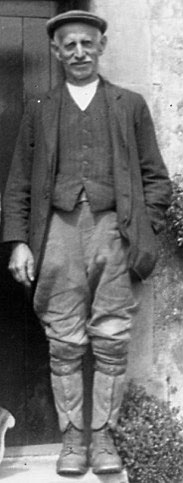
John Winn
(Joseph's brother) c.1934 at Lane Head farm, Millhouses Joseph enlisted initially at Coalville, Leicestershire in the South
Staffordshire Regiment but was transferred as a private in the Prince of
Wales Volunteers (South Lancashire Regiment) 5th Battalion, 55th Division.
Joseph died on 22 May 1918 and is buried in Houchin British
Cemetery (memorial reference I.B. 16) aged 43. His next of kin was his
brother John who gave his address as Mill House farm Tatham. He left £492.
Arthur (James) Harrison was born at Clapham in 1891. His parents were
farming at Bracken Garth in 1891 and later at High Birks, near Clapham
Station where Arthur was returned as a joiner working in Bentham in 1911.
Sometime after that his father moved to Lower and Higher Perries, Old Moor
Road, Tatham. Arthur initially joined the Royal Lancaster Regiment but
when that disbanded was transferred to the Duke of Cambridge Middlesex
Regiment.
He died on 31 May 1917* and is buried at Hem Farm
Military Cemetery, Hem-Monacu.
He is also listed on the High Bentham memorial.
History and Installation
The idea
of creating a permanent war memorial was first mooted at the parochial
church council AGM on 24 April 1919 but a decision was deferred since too
few people were present. The window was funded by public subscription.It was designed and made by the well-regarded Lancaster stained-glass
company
Shrigley and Hunt whose scale drawings (⅛ scale) were approved
by the church council on 22 April 1922. Faculty was granted by the diocese
on 10 July 1922 and it was formally dedicated on 22 August 1922 by the
Venerable Archdeacon Hornby (1853-1939), vicar of St Michael's on Wyre and
Archdeacon of the Lancaster Deanery.1
The window was unveiled by
Major Robert Hewitt Barker (1887-1961) MP for Sowerby (1918-1922). The son
of John Barker, cotton manufacturer of Stansfield Hall Todmorden, he
was also the nephew of the rector, Revd. Arthur Roberts, and his wife Mary
Jane and her sister Emily who lived with them at the rectory.2 He had
initially worked in the family business and joined the 2nd volunteer
battalion Lancashire Fusiliers on 1 March 1907 as second lieutenant,
before being transferred to 6th Battalion, Lancashire Fusiliers the
following year. He rose through the ranks as Captain and later Major.
During the Great War he served in Egypt, at Gallipoli and finally in
France, from where he was invalided home early in 1918.3 He married Violet
Kathleen Gartside at Manchester Cathedral in June 1916, the service
performed by his uncle, Revd. Arthur Roberts.4
 |
 |
Major Robert Hewitt Barker |
Mrs. Violet Kathleen Barker5 |
But it
was not just as the rector's nephew that he had been invited to perform
the ceremony.
The National Association for Discharged Sailors and
Soldiers had been responsible for nominating him as parliamentary
candidate in December 1918 when their preferred candidate, the
Conservative W.A. Simpson-Hinchcliffe, had stood down.6 Barker promised to
fight for fair treatment for soldiers, their wives and dependants.7 During
1919 and 1920 he made some 26 speeches in the House of Commons on the
issues of pay, employment and particularly pension provision but none
thereafter.8 He did not stand again, but was one of those who nominated
Simpson-Hinchcliffe in 1922.9 Thereafter he returned to the family
business but remained involved with the Territorials, achieving the rank
of Lieutenant Colonel. He was appointed a JP in 1942.10The
surplus of the subscription money was used to create the Roll of Honour
two years later.
* Arthur James Harrison Post-Script
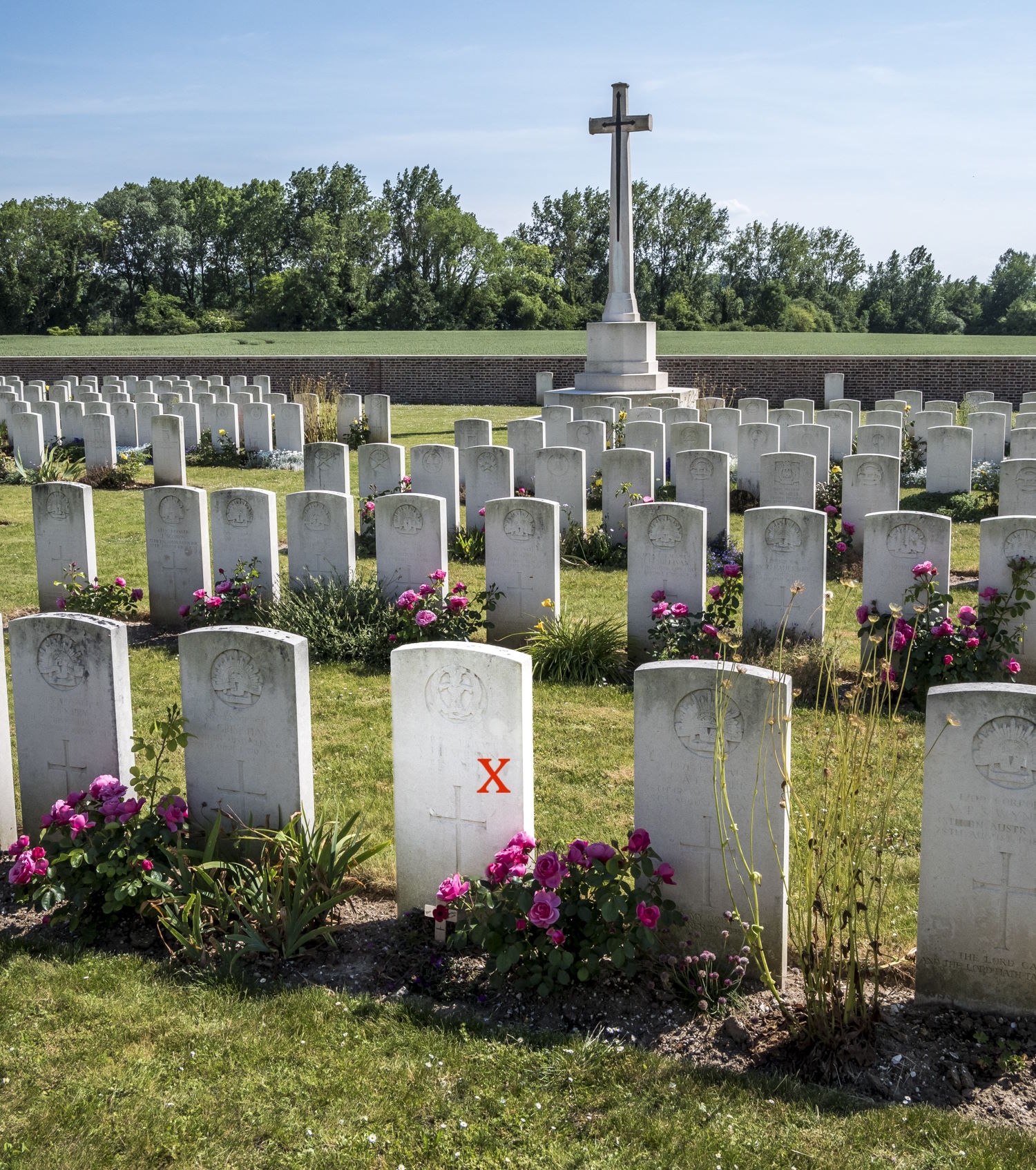
Private Harrison's grave at Hem Farm cemetery (click to enlarge) Arthur James Harrison was the subject of one of a series of
articles in The Bentham News, by Marilyn and Allan Hartley,
paying tribute to Bentham men who died in service during the First World
War. Subsequent research, by Nick Hooper, has revealed that Harrison died as the result of a
tragic accident. Two peculiarities prompted the research: (i) there is no
record of his having been killed in action; (ii) his grave at Hem Farm
Cemetery is surrounded by those of Australians.On the day he died, his unit, the 2nd Battalion Middlesex Regiment, had
not been in the front line for over a fortnight (battalion diary records) and was stationed
some distance to the west of the front, at Curlu, a village close to the
north bank of the River Somme. Harrison had initially been buried near the village of Clery,
which is just
over a quarter of a mile east of Curlu and also close to the Somme. After
the war, the bodies of the fallen were exhumed and then re-buried in
Imperial (now Commonwealth) War Grave cemeteries. All the temporary graves in the same
small area near Clery were those of Australians.
The mystery was solved by the discovery of Private Harrison's Pension
Ledger and Index card, which states that he drowned accidentally. We can
only speculate as to the circumstances, but it is possible that the
accident occurred whilst soldiers were bathing in the Somme.
References
1 Parochial Church Council minutes, St James the Less.
2 Census data. Emily's gravestone is in the cemetery on the north side of the
church.
3 London Gazette, 5 April 1907; 2nd volunteer
battalion, Lancashire Fusiliers 1 March 1907; London Gazette, 1 April
1908; 2nd lieutenant, 6th volunteer battalion.
4 Todmorden
Advertiser, 23 June 1916.
5 Tatler, 5 July 1916. (Mrs R H
Barker)
6 Leeds Mercury, 4 December 1918. This association is
not to be confused with the more radical National Federation.
7 Graham
Wootton, Politics of Influence (Routledge, 2013), pp. 130-39;
Todmorden Advertiser, 3 January 1919.
8 Hansard proceedings.
9 Todmorden Advertiser, 22 November 1922.
10 Rochdale Observer, 23 May 1942. |

